SSL Certificate Types
This article mainly introduces the types of Racent SSL certificates and the display effect of each type.
SSL Certificate Types
By the number of bound domain names (or IPs) they support, SSL certificates can be divided into single-domain certificates, multi-domain certificates and wildcard certificates; by verification method and encryption level, they can be divided into three types: DV certificates, OV certificates and EV certificates. Different types of certificates vary in security level, number of supported domain names, certificate brand and applicable website types. Users can select the corresponding certificate according to the specific situation. The following provides a detailed comparison of different certificate types based on different classification methods.
Classification by Verification Type
| Certificate Type | Verification Method | Encryption Algorithm | Security | Applicable Website Types |
|---|---|---|---|---|
| DV (Domain Validation) | Verify domain ownership and website authenticity | RSA, SHA256 | General | Personal websites, small and medium-sized enterprise websites |
| OV (Organization Validation) | Verify domain ownership and website authenticity, and also verify the authenticity of enterprise information | RSA, SHA256 | Strong | Enterprise websites, government, education, Internet sectors, etc. |
| EV (Extended Validation) | Verify domain ownership and website authenticity, and also verify the authenticity of enterprise information with stricter secondary review | RSA, SHA256 | Highest | Large enterprises, banks, financial institutions, etc. |
All DV, OV and EV certificate types meet the internationally required encryption algorithm standards. On this basis, their encryption strength varies, and different brands support different certificate types.
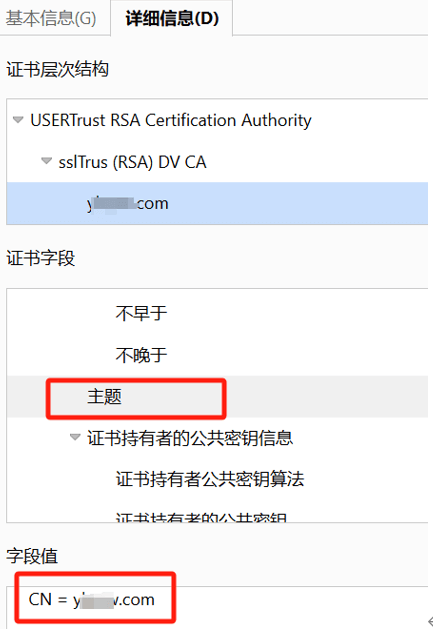
In terms of browser display, DV certificates only show domain name information, while OV and EV certificates show both domain name information and enterprise information. As shown in the figures below:
DV certificate: When clicked in the browser, only a small padlock is displayed. In the certificate, only the domain name is shown in the issuer field, with no organization or organizational unit name displayed. The subject background value only displays the domain name.


OV certificate: When clicked in the browser, a small padlock is displayed, indicating a secure connection and a valid certificate. The issuer field shows the organization and organizational unit names; the certificate subject displays the enterprise domain name information and enterprise name.

EV certificate: The certificate shows the issued subject and organization name. Due to stricter enterprise verification, in addition to the domain name information and enterprise name, the subject section also displays information such as the nature of the enterprise, the country code where the enterprise is located, and the tax ID number.

Classification by Number of Bound Domain Names
A single certificate can bind one domain name (or IP), or multiple domain names. Multi-domain certificates can cover multiple single domains, multiple wildcards, or a mix of single domains and wildcards. All brands offer corresponding products supporting this, except for a very small number of brands that only support single-domain or single-wildcard certificates.
| Domain Name Type | Description |
|---|---|
| Single domain | A single-domain certificate protects only one main domain name, one subdomain, or one public IP |
| Multi-domain | A multi-domain certificate can bind multiple single domain names by default (with no restriction on first-level, second-level or third-level domain names). After the certificate is issued, you can pay to add more domain names to the certificate. Most multi-domain certificates support binding up to 250 domain names |
| Wildcard | A wildcard domain certificate is bound to a primary domain name, and supports the primary domain name and all subdomains at its next level. For example, *.racent.com covers racent.com and all its first-level subdomains such as www.racent.com and mail.racent.com, but does not support subdomains across one level, such as aaa.mail.racent.com… |