Detailed Explanation of NS Records
What is an NS Record
NS records are used to specify the authoritative DNS servers for a domain.
For example:
Pointing www.example.com to a.racent.com indicates that the resolution of www.example.com is managed by a.racent.com.
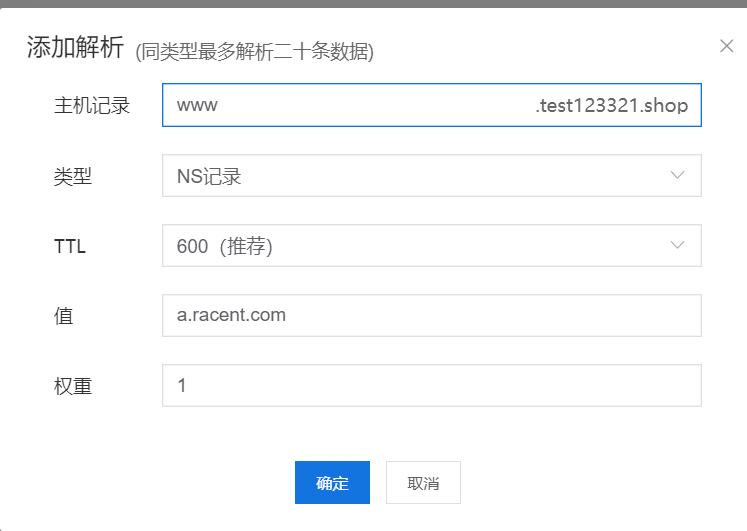
Adding an NS Record

Host Record:
-
@represents the root domain (e.g., example.com) -
wwwrepresents www.example.com -
Other specific subdomains
Type: Select NS record
TTL: 600 seconds (recommended)
Value: Enter the domain name of the DNS resolution server (e.g., a.racent.com)
Weight: If there are no special requirements, you can uniformly enter 1.
-
TTL is the time-to-live for DNS records in the cache of recursive DNS servers.
-
The unit is seconds. A shorter TTL means DNS changes take effect faster; a longer TTL results in a higher cache hit rate and more stable resolution speed.
-
600 seconds (10 minutes) is a common compromise value that balances flexibility and stability.
A higher weight value means a higher proportion of traffic will be assigned to it. This only takes effect among records of the same type.
Notes
1. A valid domain name must be used as the NS
- Do not enter an IP address directly; you must fill in a complete domain name, such as
ns1.example.com
2. It is recommended to configure at least two NS records
- The standard practice is to set a primary NS and a secondary NS to ensure DNS resolution redundancy and stability.
3. NS domain names must be resolvable
- The configured NS itself must be accessible; otherwise, domain name resolution will fail.